The proportions and appearance of a Schnauzer
Schnauzers are among the most beautiful and proportionate dog breeds, and due to their size and color variations, they are rightly mentioned among the most popular dog breeds. According to the German standard, all size and color variants have the same proportions.
The aforementioned standard clearly stipulates the more important proportionality requirements, but there are aspects that the official breed descriptions do not mention. The concept of "harmonious body structure" is often mentioned, so it is worth examining more closely what makes this breed proportionate and harmonious.
Three important proportionality requirements
In this paper, we will discuss three important proportionality requirements because these most noticeably influence the appearance and movement.
1) The section of the spinal column that extends from the beginning of the withers to the base of the tail is called the topline. On this topline, we distinguish three well-defined sections. These three sections are the back, the loin, and the croup, and the length of these three sections relates to each other as 2:1:1.
2) The imaginary longitudinal axes of the shoulder blade and the pelvis intersect above the back and form a right angle. A vertical line drawn from this intersection point towards the ground passes through the dog's center of gravity.
3) The line drawn between the shoulder joint and the hip joint, as well as the A-B section, is parallel to the line drawn through the elbow and knee joints, as well as the C-D section.
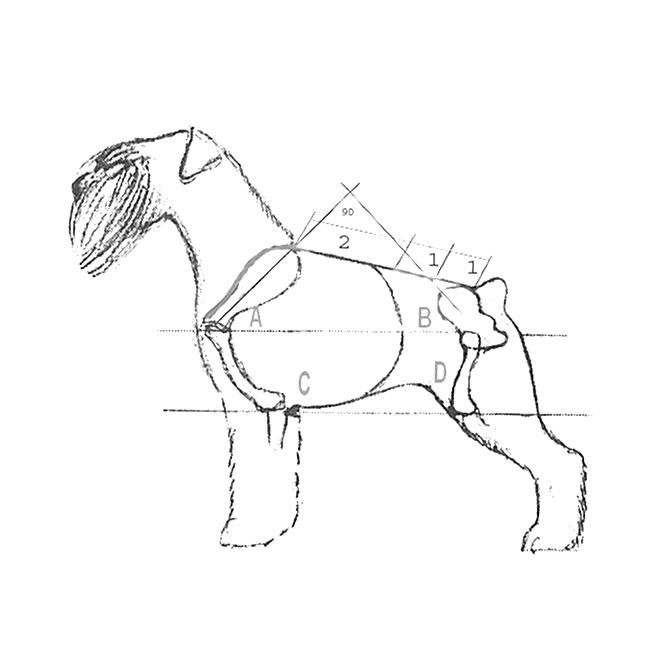
1./ From this examination of the topline, it is clear that half of the topline is the back section. It is also good if the back is long, as the spinal column and the ribs attached to this section stabilize and solidify the dog's body, providing adequate space for the heart and lungs. An important requirement for Schnauzers is a short, well-coupled loin and a croup of the same length as the loin. If the above conditions are met, the stance is stable, and no swaying occurs on the back during movement. The pushing force in the direction of movement is not broken or weakened by unnecessary vertical oscillating motion from the back.
2./ If the angle between the shoulder blade and the pelvis is ninety degrees, it is easy to see that the front and rear of the spinal column are symmetrically supported. In this case, the dog is not uncomfortable in its stance, and the dog does not need constant adjustment of its legs during exhibition; the dog can position itself in a standard manner. During movement, the dog behaves physically like a pendulum swinging symmetrically in two directions on the axis of intersection, making the movement balanced and smooth.
3./ The requirement for the two parallel lines can be explained as follows. This condition can only be met if the length of the humerus and the length of the femur are in an ideal ratio to each other. Additionally, the angles of the shoulder joint and the hip joint must relate to each other in such a way that parallelism is achieved. This also ensures that the stride length of the front and hind limbs is equal during trotting, creating a synchronized, diagonal movement from paw to paw.
As a supplement, it should be mentioned that beyond the three conditions discussed, there are many other aspects to consider. Several articles have been published in the FCI magazine on the biometric analysis of dog anatomy for other dog breeds as well.